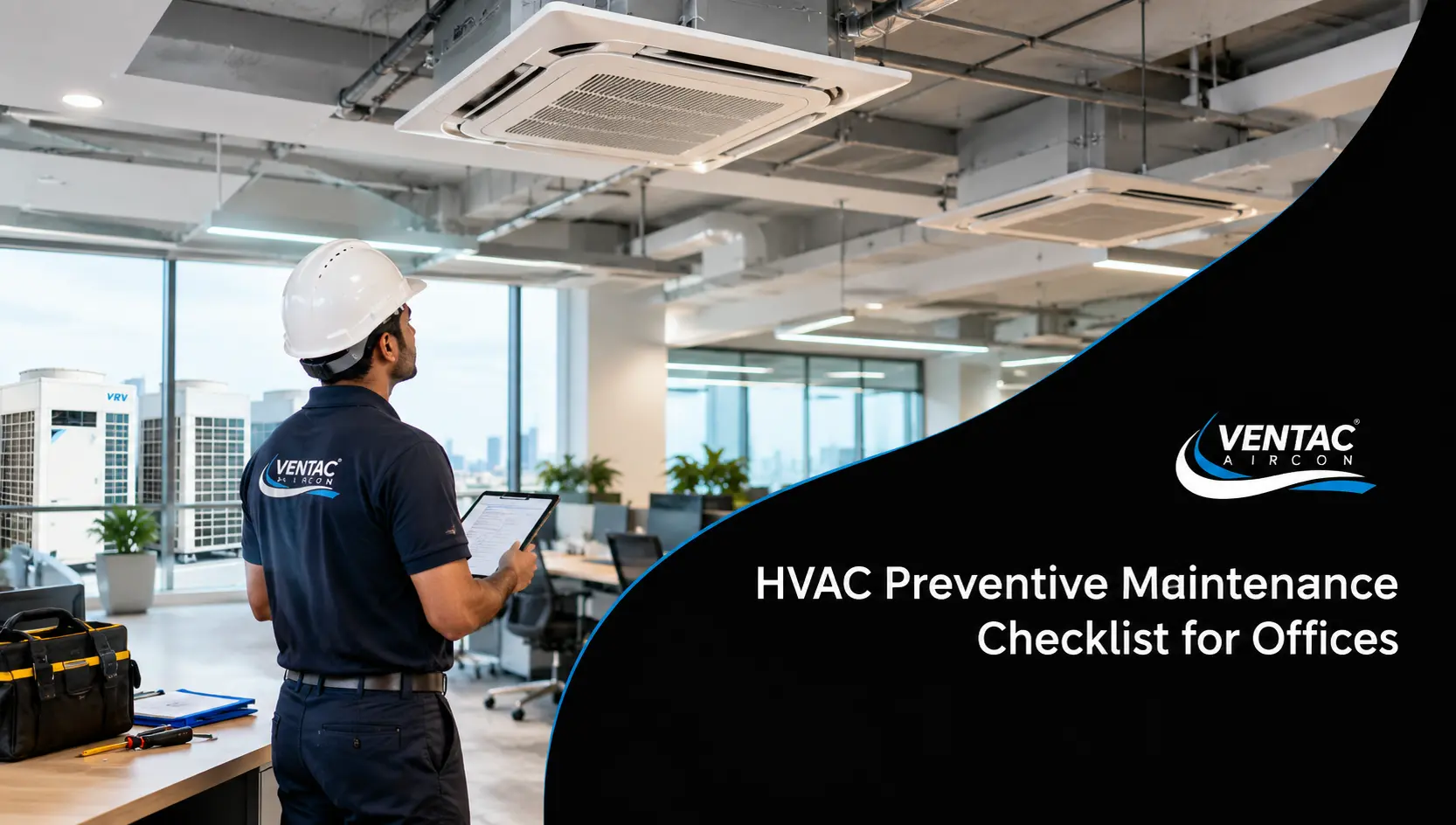
HVAC Preventive Maintenance Checklist for Offices
A pleasant working environment is not only determined by turning on the air conditioning system. HVAC systems work long hours with varying indoor and outdoor conditions. However, without routine checking and servicing, small problems like filter blockage, refrigerant, airflow, and controls can slowly influence the quality of the environment and energy consumption.
By following the checklist to undertake preventive maintenance for the HVAC system, one can avoid these problems before they become expensive ones. It is crucial to understand this especially in the case of office buildings that use VRV systems as all the parts mentioned above need to work together.
Maintenance should not be limited to cleaning of filters only, but also testing of the electrical components, testing of air flow, performance test of operation, cleaning of the heat exchanger components, drain testing, and control testing. It is equally important for the functionality of the VRV air conditioner in meeting rooms, offices, cabins, receptions, and other places.
One of the methods through which the continuous running of the HVAC equipment can be achieved is planned maintenance. This guide will give you an idea of what must be included in your preventive maintenance program for the office HVAC equipment.
Why HVAC Preventive Maintenance Matters in Offices
Operating conditions for HVAC in offices are quite harsh. The HVAC system runs throughout the whole work period and operates in areas which contain different loads of people and equipment at different temperatures.
Over time, issues like accumulation of dust, filter blockage, dirty coils, drainage issues, defective electrical wiring, and controls may lead to low efficiency of the system. What may initially appear to be a trivial problem can lead to failure of the system later on.
Preventive maintenance is the way by which one can switch from reactive actions to predictive actions. It entails no more waiting to get information regarding hot rooms and odd noises from machinery before evaluating them.
For example, if one of the conference rooms is spending excessive time reaching the desired temperature level, some of the probable reasons might be improper airflow, dirty indoor coils, incorrect setting, or any other issues concerning the system itself. This scenario could be considered as an occasion for maintenance of the HVAC system.
This strategy is quite effective in commercial buildings because of its influence on the employees and operations of the business in case of a problem with the system.
Office HVAC Preventive Maintenance Checklist
A good maintenance schedule should be able to cover the entire system of the HVAC system and not just its individual parts. The needs may vary depending on the nature and age of the system.
Among others, the following must be checked by maintenance crews at the very minimum:
- Air filters, inside coil system, drain pan, drain line, and air flow.
- Outside unit, refrigeration piping, electrical connections, fan, and heat exchanger.
- Thermostat, control, sensor, wiring, setting, and protection devices.
Additionally, the procedure for conducting inspections must entail analysis of previous records on maintenance. This will help to determine any changes in performance trends by comparing past and current values.
For instance, even higher operating currents and some drainages do not automatically mean there is a problem; however, they can be very useful to identify any problems that exist.
The best professional maintenance record book should include details such as the date of the inspection, the equipment under inspection, the findings, action taken, and the recommendation of the technician.
VRV System Maintenance: What Facility Teams Should Check
Maintenance should be synchronized in a VRV system due to the fact that there is one outdoor unit serving several indoor units in different sections of the office. The functioning of such systems depends on their interaction through outdoor units, indoor units, refrigeration piping, control systems, and sensors.
The individual indoor and outdoor units should be checked separately in addition to examining the working of the entire AC system as a whole. Sometimes, the variation in cooling capacity among different rooms may show that there is a problem with a specific indoor unit.
Refrigerant tests can only be carried out by certified HVAC professionals using the appropriate technique and tools. It should be noted that refilling of the refrigerant is not equivalent to diagnosing it.
It is also important for the maintenance team to check error codes and history of the equipment when these facilities are offered by the equipment. Error codes can provide information about problems which may not be easily found through a simple inspection of the equipment.
If there are any office refurbishments or extensions, the maintenance team should also ensure that the changes made in the room affect the original design of the HVAC system.
Indoor Unit and Airflow Maintenance
The indoor unit influences directly the quality of the air being supplied indoors, making it essential for preventive maintenance.
The filters should be cleaned or changed as needed and according to the recommendations of the manufacturer. The offices located in the regions where there is construction activity and heavy traffic require more maintenance than those in the clean environment indoors.
Coils located inside buildings need to be checked to determine whether there is any dirt buildup. Dirt in coils may affect the heat exchange process, which will reduce cooling performance. It is important to check drain pans and condensate lines because they might be blocked leading to water leaking around the indoor units.
Another area where technicians should look into is the airflow, especially in areas where temperature inconsistency is reported by the occupants. Airflow can be tested using fans, louvers, and filters. This is particularly important in offices where furniture, partitions, storage units, or interior modifications have changed the distribution of conditioned air.
Outdoor Unit and Refrigeration Checks
The outer unit is the unit that rejects the heat from the building and plays a major role in improving the cooling efficiency of the system, thus the environment of the outer unit should have no unnecessary obstructions.
Dust and dirt on the coils and noise from the outer fan units should also be checked.
VRV outdoor unit installation requires several important things, such as clearance, accessibility, proper equipment location, piping arrangement, and electrical connection. Nevertheless, after the installation process, it is necessary to keep an eye on those aspects as well since any changes in equipment vicinity may influence maintenance and airflow.
It is very crucial to identify any kind of damage, abnormality or insulation problems in the pipe of the refrigeration system. However, if there is any suspicion of leakage in the refrigerant system, then it must be inspected by the expert rather than just recharging it.
When there is a great need for cooling, then it becomes vital to inspect the external components of the system. It is certain that there is going to be no possibility of any breakdown when there is any problem related to airflow, dirty coils and fans.
Electrical and Control System Inspection
Since the HVAC system operates through electrical components and controls, it is important that preventive maintenance involves checking the electrical components including connections, control panels, sensors, wires, and others.
There are various indicators technicians can check during the process including loose connections, overheating, faulty wires, unusual electrical signals, and equipment malfunction. Any electrical work should be performed by qualified personnel.
The modern office system is equally dependent on the thermostat, central control system, BMS, and sensors. Any problem with the temperature readings and any sort of communication failure will cause operations to be different than what they should be.
The following example shows an instance where the air conditioning system continues to operate even outside work hours because of incorrect scheduling. Though the system is performing efficiently, but the incorrect programming of the control setting can result in the wastage of energy.
Testing for the efficiency of the control setting, scheduling, and sensors is equally important.
HVAC Ductwork and Ventilation Checks
However, not all offices use HVAC systems in the same way. Ducted equipment is used in some offices, but other offices make use of indoor units only. If the ductwork system is present in an office, then it must be included in the preventive maintenance process.
The ducts, grilles, diffusers, insulation, flexible connections, and access panels must be checked for any problems. What this means is that there is less cold air in the required area. Second, placing the diffusers and blocking the diffusers will result in uneven temperature distribution.
The distinction between cooling and ventilation needs to be understood. Cooling is possible in an office but this does not imply that there is proper ventilation in the office. It is very crucial that the employees in the office ensure that there is proper ventilation in the office.
However, in larger commercial buildings, a combined system of vrv hvac may consist of a number of cooling zones along with the ventilation and other building services. In order to properly maintain the above mentioned system, it is essential to look into the relationship between them.
How Often Should Office HVAC Maintenance Be Done?
The maintenance period cannot be universal for all offices as it differs from one office to another depending on the type of equipment, manufacture's advice, number of hours in operation, internal air quality, and environmental conditions.
The filters may require servicing more often than other parts especially when the atmosphere is dusty. However, more frequent checks can be arranged for different periods during the year depending on the manufacturer's recommendations and the needs of the building. One good method of classifying maintenance is through daily observation and inspection, periodic preventative inspection, and servicing.
For instance, the facility personnel may keep a watch on abnormal noises, temperature complaints, water leakage, and other issues that occur regularly. The qualified HVAC technicians can do their routine technical inspections and document the measurable operation.
In this way, the facility personnel can get rid of the visible problems, and at the same time can maintain their technical maintenance system.
Common Signs Your Office HVAC System Needs Attention
Maintenance work must not be regarded as an escape route from the problems that arise because of the HVAC system. Maintenance personnel should focus on the odd behavior of the HVAC system, especially if it is happening repeatedly.
Signs of problems include:
- Un-even cooling throughout rooms or levels.
- Leakage of water, strange sounds, vibrations, or repeated error messages.
- Increased energy consumption and longer cooling times without an increase in the number of people.
For example, if those individuals who work within a particular area of the office notice that there is excess heat in that area compared to other areas, then cooling alone cannot solve the core issue. There may be other issues that require attention.
In addition, continuous leakage of water from the indoor unit of the air conditioner must be addressed. This could indicate that there are certain issues with the machine.
Creating an Effective Preventive Maintenance Schedule
Good maintenance begins with an accurate inventory of equipment. It is essential that every indoor unit, outdoor unit, ventilation, control panel, and other important HVAC equipment has a unique identifying number and equipment data. The facility can then use that information to schedule maintenance according to the requirements of the equipment and building operation. Ideally, maintenance should be scheduled outside busy business periods.
The documents must show the date of inspection, equipment identification, observations, measurements where necessary, the cleaning done, replacement of parts, problems identified and recommended next steps. Such a record becomes very useful for a large office having several HVAC zones. This is because rather than depending on his memory, he can go through the past records to learn about repeat occurrences.
Procurement managers can also rely on maintenance data while assessing whether to repair or replace a particular asset. If a unit keeps on needing more repairs, then it needs a more comprehensive life cycle evaluation, rather than one more repair.
Standardized checklists can be helpful for companies that have a number of facilities to ensure consistency in maintenance procedures.
Conclusion
The well-organized HVAC preventive maintenance program ensures that the office space enjoys continuous comfortable conditions inside as well as offers more visibility into the health of equipment for the facility management team. The procedure should not be confined to simple filter cleaning but should also cover many other aspects.
The installation of the VRV air conditioning system will require the building to undertake inspections because there are many indoor units involved in such installations. This will ensure that any problems that arise are identified beforehand so as not to disrupt the operations of the facility.
Ventac Aircon can support businesses with professional HVAC solutions, maintenance planning, and technical services tailored to commercial requirements. A structured maintenance approach gives facility managers and business owners a clearer way to manage HVAC performance throughout the equipment lifecycle.