
How to Plan HVAC for a 24/7 Data Centre: Cooling, Airflow & Redundancy Guide
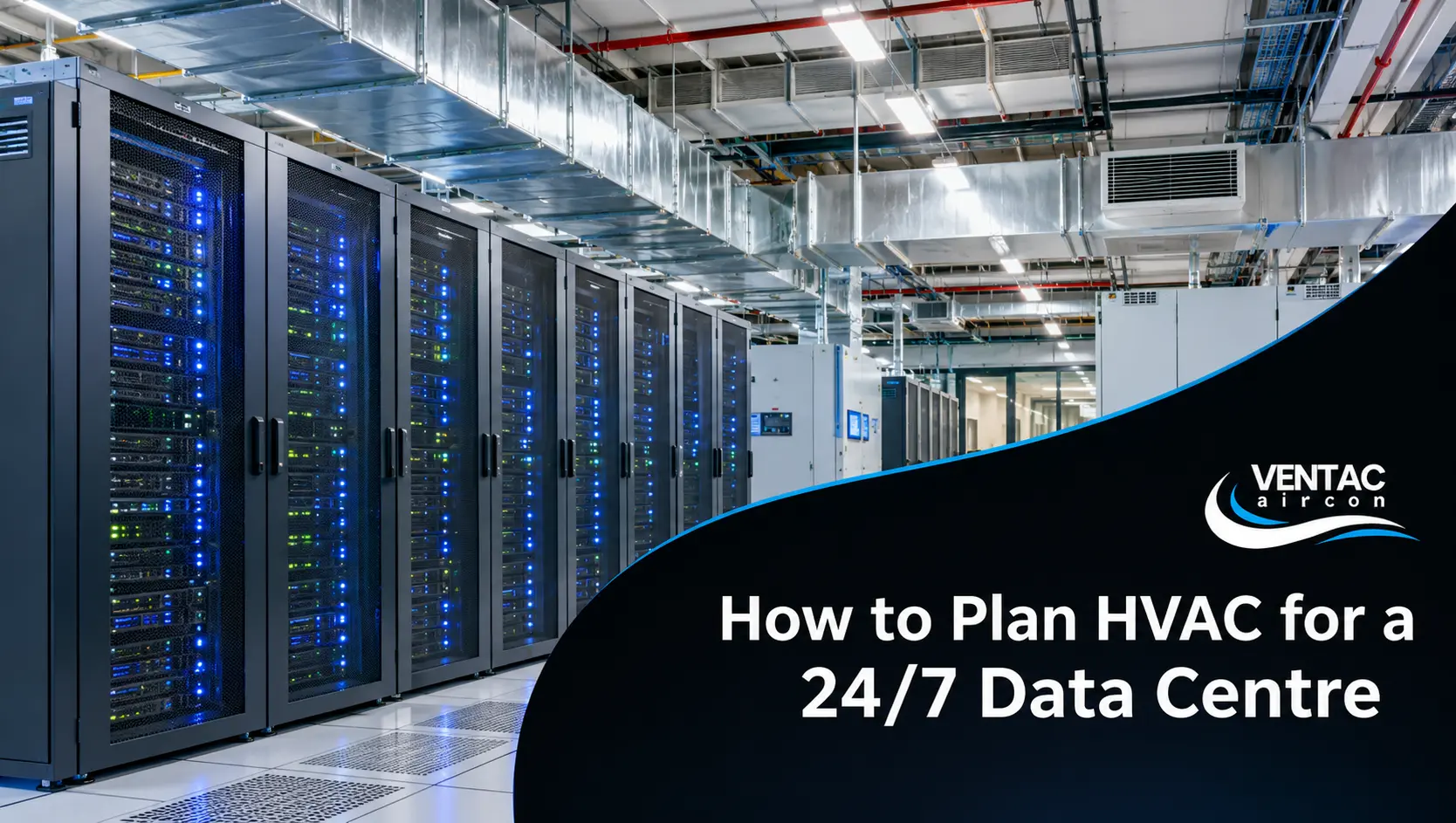
Data centers function on a round-the-clock basis, offering essential digital services, software, cloud computing, banking infrastructure and communications networks. In contrast to traditional commercial buildings, there is no scope for any unforeseen failure of cooling in such buildings. Such a failure may have negative impacts on the functioning of servers and other computer devices.
HVAC design for data centers that operate on a constant basis over the 24 hours a day involves much more than simply selecting the right type of air conditioning system that can provide sufficient cooling. It involves knowledge about the heat load from the IT equipment, proper airflow, temperature, humidity, and backup cooling.
In addition, a good HVAC system should be designed in such a way that it can cope with variations in the load on the servers and any future growth in the equipment as well as the outside environment.
When a company is building a new data centre or upgrading an existing one, this information can help them avoid costly design errors. With Ventac Aircon's expertise in HVAC design and installation services, we know that dependable mechanical systems are key in environments where consistent uptime is critical.
Herein will be provided an outline of the various things that must be considered when designing a reliable data center cooling system.
1. Understanding HVAC Requirements in a 24/7 Data Centre
The HVAC requirements of a data center are not the same as those of an office, hotel, or commercial building. The HVAC requirement of an office is to maintain comfort. The HVAC requirement of a data center is to cool down the heat produced by IT equipment.
Heat is always being created by the process of heat creation in the server, storage arrays, networking, and power supply at all times. The more servers that are added into one area, the more heat will be produced. Heat can only be produced if there is no cooling mechanism.
As such, it is imperative for the data center HVAC system to do the following:
- Sustain a stable atmosphere close to the server components.
- Provide sufficient airflow to every server rack.
- Constant dissipation of the heat, even when equipment repairs and failures are going on.
- Growth capability without affecting the entire cooling system.
Another important thing is that the data centers operate round the clock whatever the weather outside may be. The weather in Gurgaon or NCR as a whole needs to be taken into consideration by HVAC engineers, because it is extremely hot in summers.
The cooling system design must be guided by the needs of the computer equipment and not just following the standard HVAC practices for commercial buildings.
2. Calculating the Cooling Load Accurately
The calculation of the cooling load is the critical process in the HVAC design for the data center. Equipment selection solely based on the floor area will not guarantee appropriate cooling.
Unlike in conventional buildings, where cooling load depends on people, lighting, openings, and outdoor air, cooling load in data centers comprises of an important percentage resulting from electrical appliances.
The majority of electricity used by IT hardware ends up as heat, which is removed by the cooling system.
Understanding the major heat sources
Cooling load analysis should take into account server racks, network equipment, storage equipment, UPS equipment, power distribution equipment, lighting, people, and heat infiltration through the building envelope.
For instance, consider that you have a data center having 20 racks of server, each rack is using power on an average of 8 kW. The heat produced by only this IT infrastructure will be about 160 kW.
This is only a rough estimate. There are other considerations also which need to be considered when calculating the cooling load.
Why rack-level calculations matter
Two data centers with similar room sizes can differ in their need for cooling. The one can house low density server racks spread throughout the room while the other can have high density racks occupying only a small portion of the room.
That is why it is essential for the engineers to estimate heat loads for the room as well as the individual rack.
In addition to this, this would help to determine whether the normal air-conditioning system used in the rooms would be adequate or if an in-row air-conditioning system or even chip-level air-conditioning system is necessary.
It would be best to calculate the cooling capacity in accordance with the IT loads rather than the square footages.
3. Choosing the Right Cooling System
After determining the cooling load, the next step is to choose the cooling system that is most suitable.
The selection of the cooling system will depend on several aspects like the size of the data center, rack density, utilities, weather conditions, redundancy, and scalability.
There could be many types of cooling systems from which one can choose.
Computer Room Air Conditioning (CRAC)
The CRAC unit was specifically designed for computer rooms or data centers. Generally, the means that they have adopted to cool the air involve using the refrigeration process.
These pieces of equipment are appropriate for buildings which need their cooling systems placed in them.
Computer Room Air Handling (CRAH)
The CRAHs employ a source of chilled water from outside chiller plant, which is circulated through cooling coils in order to absorb heat and deliver cooled air back to the data centre.
They prove quite helpful in bigger data centres where chilled water plant is used to cool several cooling units.
Chiller-based cooling systems
For medium-size to large-scale data centers requiring significant cooling capacity, chiller-based solutions are usually preferred.
In the system, chilled water is used to cool down using CRAH units or other forms of heat exchangers. For the configuration of the chiller system, either water-cooled or air-cooled systems could be opted.
In-row and liquid cooling
Another cooling solution is proximity cooling, which is required in case of a high density server environment.
In-row cooling solutions are installed between the server racks; therefore, the distance between the cooling solution and the server is reduced. In case of liquid cooling, the cooling process is conducted through liquid circuits instead of air flow in the room.
This type of cooling solution is required when dealing with HPC and AI solutions, which have very dense heat loads.
Where VRV systems fit into data centre planning
VRV systems have applications in specific auxiliary sections of the data center facility, like administration office, conference rooms, security rooms, etc.
But it is not always wise to take VRV air-conditioning systems as the main solution for cooling the critical server room. A data hall needs specialized cooling systems, the capability of removing heat constantly, well-engineered airflow, and a backup system that has been built keeping IT in mind.
In case you need VRV HVAC systems for your projects in Gurgaon, then it should be done independent of critical data hall cooling systems.
4. Designing Effective Airflow Management
Not all servers are getting adequate cooling, despite having sufficient cooling capacity.
Efficient airflow is responsible for making sure the conditioned air gets into the equipment inlet ports and the exhausted air gets back to the HVAC equipment without mixing with the supplied air.
Even if there is adequate HVAC capacity, poor airflow can still cause hot spots.
Hot aisle and cold aisle arrangement
Containment systems enhance the system since they separate hot and cold air streams physically.
Cold aisle containment involves enclosing the cold aisle so as to prevent the conditioned air from escaping before it enters the server. Hot aisle containment involves capturing the heated air and directing it to the return air stream.
The choice will depend on the configuration of the facility and the cooling system employed.
According to ENERGY STAR, proper organization of the aisles and their containment results in reduced energy consumption for cooling purposes.
Preventing airflow obstructions
It is imperative that the air flow path must not be hindered during the operation of the facility.
Some of the hindrances in the air flow path could include bundled wires, improperly located floor tiles, unused space, and improperly located equipment since even a small hole or gap in the raised floor or rack would allow air to move through without fulfilling its objective.
Appropriate installation of blanking panels, cable openings, appropriate installation of perforated floor tiles, and closure of holes would ensure that there is proper air flow path.
One of the instances is where the inlet temperature of a server rack is higher than the inlet temperature of the neighboring server racks.
5. Maintaining Temperature and Humidity Levels
Temperature control and moisture control are very important when it comes to the protection of delicate electronic parts.
High temperatures can be very stressing for the machine, while high levels of moisture can bring about static electricity dangers.
However, maintaining extremely low temperatures would be a waste of energy.
Environmental conditions recommended for processing areas by ASHRAE for different categories of equipment. The temperature range proposed for the most prevalent air-cooled equipment categories A1 to A4 will fall in the range of 18°C to 27°C. Humidity is also an important factor besides temperature.
These figures should not be misunderstood to be universally applicable. There will definitely be variations depending on the manufacturer of the server and so many other factors.
The target of controlling humidity must be keeping the proper humidity levels without having too much humidifying or dehumidifying of the system.
For instance, in developing HVAC systems for areas like Gurgaon that are affected by seasons in terms of moisture content of the outside environment, this is something that needs to be considered during designing such systems.
The location of humidity and temperature sensors must be made at the server inlet points and not the room thermostat point.
6. Planning HVAC Redundancy and Reliability
There is no chance that the data center can depend on one cooling system being always available for functioning without having some alternatives ready for contingencies.
In the event of malfunctioning of the primary cooling system, the temperature of the server will rise very rapidly, particularly in cases where the density is higher.
Understanding N, N+1 and 2N configurations
It is an illustration of how different types of increased capacity for cooling can be done.
- N Capacity Configuration: The capacity of the installation is the same as the actual capacity of cooling required. There is no surplus capacity for equipment in case of failure.
- N+1 Capacity Configuration: In addition to the capacity of cooling required, there will be one extra capacity for cooling equipment.
- 2N Capacity Configuration: Two separate systems which will do the work of the capacity of cooling required.
The type of configuration depends on the availability goals of the facility and its budget, maintenance needs and infrastructure class.
It is vital to note that having redundant equipment alone is not sufficient for continuous operation as power supplies, control systems, pumps, valves, pipelines and many others have to be considered as well.
For example, two chillers will not ensure resilience if they are dependent on one unreliable pump or power distribution system.
In addition, the cooling configuration has to allow for maintenance without reducing necessary operational capabilities.
7. Improving Energy Efficiency and PUE
Cooling can account for a substantial amount of the total energy consumed in a data center. It should be considered during the design phase, and not while running the data center.
One of the critical things to consider is the Power Usage Efficiency (PUE).
The calculation of PUE is as follows:
PUE = Total Data Center Facility Energy Consumption / IT Equipment Energy Consumption
When low values are achieved with respect to PUE, this clearly indicates the necessity of using extra energy for carrying out operations by IT equipment.
However, what is crucial here, is the fact that the factor of PUE needs to be considered in combination with such factors as reliability, inlet properties, and efficiency of the equipment.
Various technologies are available which may contribute to increasing the effectiveness of this process.
Thus, the first technology implies that it would be possible to use such equipment as fans and pumps which will ensure control over the air/water flows. The second one is called the economizer method.
Thirdly, effective containment helps prevent any mixing of hot and cold air, thereby making it easier for the cooling units to work more effectively.
The US Department of Energy guide on data centre designs highlights the importance of optimizing air flows, fan controls, and cooling units.
Small gains in the efficiency of cooling can lead to big savings in a business that operates all year round.
8. Integrating Monitoring and Automation
The HVAC system within the data centre must continuously keep track of the environment and the efficiency of the equipment.
Manual checks will not be enough for 24-hour operations. An automated system will help facility operators discover the potential problems early.
A Building Management System (BMS) is capable of monitoring cooling equipment, pumps, fans, chilled water temperature, humidity and more.
There may also be additional benefit from implementing a DCIM system for more visibility regarding IT assets, power usage, rack environment, and related infrastructure.
Key monitoring parameters include:
- Inlet and outlet server temperatures.
- Relative humidity and dew point.
- Supply and return chilled water temperatures.
- Cooling unit operation and alerts.
- Fan speeds and air flow with energy usage of equipment.
Take for instance when the cooling mechanism is not working, the control system needs to detect the problem and inform the right people along with making the right back-up plan when possible.
The intelligent controls will also be able to regulate the cooling of the servers using their input conditions and not cool the whole area.
9. HVAC Installation and Commissioning Considerations
Nevertheless, an even well-designed HVAC system would not function effectively if it was installed and commissioned incorrectly.
It is essential to work in collaboration with all structural, electrical, plumbing, fire protection, and IT departments before commencing the installation process. This will ensure that it is unlikely that any clash will occur between ducts, chilled water pipes, wires, and others.
It is equally necessary to make arrangements regarding accessibility and maintenance, drainage, electrical supply, and proper pipework of refrigerant/chilled water.
In the process of commissioning, it is important that the installed system operates in accordance with the approved design.
Some critical tests to be carried out include measurement of air flows, chilled water flows, temperatures, humidities, operation of equipment, alarms, and back-up systems.
It is also essential to conduct failure simulations to ensure that the stand-by equipment behaves as expected.
This means that the engineers are able to verify any failure occurring in one of the units and find out if the other units will be able to supply the required temperature at the inlet points of the servers.
Where a project includes VRV outdoor unit installation for non-critical areas, the outdoor units should have suitable ventilation, service access, structural support and refrigerant piping arrangements. These requirements should be coordinated with the overall building HVAC design.
Commissioning of cooling systems allows the facility manager to have confidence in the cooling systems before commissioning of the facility takes place.
10. Preventive Maintenance for Continuous Operation
Maintenance of HVAC systems does not consist only of regular cleaning in a data centre, which operates 24 hours a day. Maintenance of HVAC system is necessary to ensure reliability of cooling and safety of IT equipment.
Preventive maintenance schedule needs to be established based on recommendations of equipment producers, conditions of operation and maintenance policy of the facility.
Filters must be checked and cleaned or replaced if needed. Fans, motors, belts, coils, pumps and electrical connections need to be tested.
Water-cooling systems must be checked for leakage, flow rate, water quality, and insulation status. The refrigeration system must be checked for unusual pressure and temperature levels.
The calibration of sensors is equally vital. If the temperature sensor is incorrect, the cooling equipment will malfunction even when its parts are working perfectly.
It is important that maintenance schedules are set according to the redundancy plan of the building. It is necessary to confirm that the remaining equipment can handle the operational load before removing any cooling unit.
The knowledge of Ventac Aircon in installing and maintaining its HVAC system is an indication of the significance of planned maintenance in maintaining the effectiveness of the mechanical system.
Planning for maintenance makes it easier to detect emerging problems and also avoids any unexpected breakdowns.
11. Common HVAC Planning Mistakes to Avoid
There are various planning errors that could have an impact on the performance and efficiency of the data centre operations.
- Not taking into consideration the energy consumption: The cooling needs of the data center are highly dependent on IT power consumption and rack density. Floor space calculations alone will not be sufficient.
- Not looking ahead to the future growth of the facility: The cooling system needs to consider future server additions and changes in rack loading capacity.
- Failure to address airflow: Adding highly efficient cooling solutions will not compensate for inefficiencies due to improper rack placement and hot-air recirculation.
- Insufficient redundancy: If there is no suitable plan of backup for the cooling design, then the critical hardware will remain unprotected during any service or malfunction.
- Lack of commissioning and maintenance: Improperly tuned airflow, uncalibrated sensors and malfunctioning components can decrease system efficiency despite a good initial design.
Preventing such errors involves good coordination among the design consultant, HVAC contractor, equipment supplier, and facility management team.
12. Conclusion
Design of HVAC system in a 24-hour data center depends on different factors, which may involve cooling capacity, reliability, air flow and efficiency among others. It does not need the same HVAC system that any other commercial building needs because its cooling needs have to work 24 hours a day.
Cooling load calculations that are accurate, CRAC/CRAH systems that suit the requirement, hot aisle/cold aisle configuration, redundancy as well as monitoring all go into making reliable operation.
Professional installation, commissioning, as well as preventive maintenance, are equally important in ensuring that the cooling equipment functions as required for its lifetime.
For companies who have plans to set up the data center infrastructure or upgrade their current HVAC installations, it makes sense to get assistance from HVAC experts.
Ventac Aircon has been in existence since 1993. Ventac Aircon is a company that specializes in the design, installation and implementation of HVAC systems following the sales stage. Ventac Aircon is an organization composed of professionals who mainly concentrate on efficient HVAC services.